What Football Betting Odds Really Tell You
- Primary Signal: What Football Betting Odds Really Tell You
- Overview: Football betting odds show both payout and implied probability. This guide converts decimal, fractional and American odds and explains what they cannot tell you....
- Verification: Analyzed and compiled by Global Football Odds editorial monitoring desk.
Football betting odds tell you two things at once: how much you stand to win, and what probability the bookmaker assigns to an outcome. They are not a prediction that an outcome will happen, and they are not a promise of profit. They are a price, set by a market, with a margin built in. Learning to read that price, rather than just picking a team, is the skill that makes odds useful.
Odds come in three formats that all describe the same price. Decimal odds, common in Europe and international markets, show your total return per unit staked, including your stake. A price of 2.50 returns 2.50 units for every 1 unit staked, which is 1.50 units of profit plus your stake back. Fractional odds, traditional in Britain, show profit relative to stake: 3/2 means 3 units of profit for every 2 staked, plus your stake back. American odds use a 100-unit reference: +150 means 150 units of profit on a 100-unit stake, while -150 means you must stake 150 units to win 100.
Every price can be converted to an implied probability, which is the break-even chance the price implies. For decimal odds, divide 1 by the odds: 1 divided by 2.50 is 40 percent. For fractional odds, divide the denominator by the sum of numerator and denominator: 3/2 gives 2 divided by 5, which is also 40 percent. For American odds, positive odds use 100 divided by odds plus 100, so +150 gives 100 divided by 250, which is 40 percent. All three formats agree, because they are the same price in different clothing.
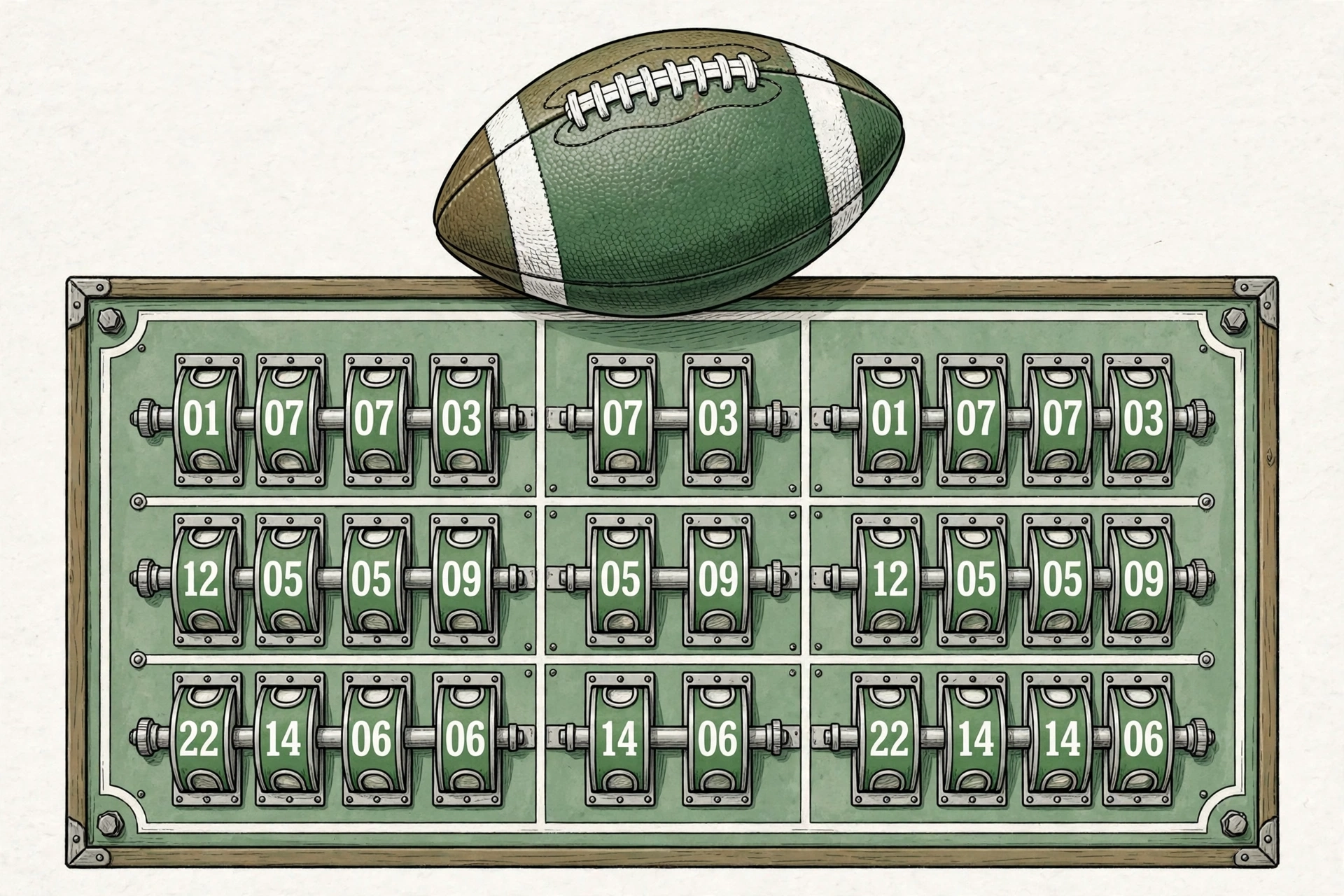
A conversion table makes the pattern obvious. A price of 1.50 in decimal is 1/2 fractional and -200 American, implying about 66.7 percent. A price of 2.00 is 1/1 and +100, implying 50 percent. A price of 2.50 is 3/2 and +150, implying 40 percent. A price of 3.00 is 2/1 and +200, implying 33.3 percent. Notice that prices below 2.00 mark a favourite, because the market considers that outcome more likely than not, while prices above 2.00 mark an underdog.
What odds do not tell you is just as important. Because bookmakers build a margin into every market, the implied probabilities of all outcomes add up to more than 100 percent, typically around 105 to 110 percent on a three-way football market. That excess is the bookmaker's margin, and it means the implied probability is not the true probability: it is the market's estimate inflated by the margin. A price implying 40 percent does not mean the outcome truly happens 40 percent of the time.
So what should you actually read from a price? First, the favourite and the underdog: lower prices mean shorter odds and a more likely outcome in the market's view. Second, the payout: multiply your stake by the decimal price for total return, then subtract the stake for profit. Third, the margin: if you convert every outcome in a market to implied probability and the total is far above 100 percent, the market is expensive. Odds reward readers who convert prices into probabilities and compare them, not readers who simply back the biggest number.
Q: Which odds format is best? A: None is more accurate. Decimal is easiest for calculating returns, fractional is traditional in Britain, and American is standard in the United States. They describe the same price.
Q: Does a low price mean a team will win? A: No. A low price means the market considers that outcome more likely, not certain. Favourites lose regularly.
Q: Why do implied probabilities add up to more than 100 percent? A: Because bookmakers build a margin into the market. The excess above 100 percent is that margin, not extra probability.
📖 Continue Reading the Full Story
Continue reading this article on Global Football Odds.
⚡ Access Full Content NowMore from Global Football Odds



 📋 Football2026 Tactics
How to Read Asian Handicap Football Betting Odds: A Beginner's Guide
Asian handicap odds look confusing at first glance, but they follow a simple logic: a virtual head start or de...
 📈 FootballBet Center
How to Compare Football Betting Odds Across Bookmakers (Line Shopping Guide)
The same football bet often carries different prices at different bookmakers, and that gap is free extra retur...
 🤖 WinBar AI
How to Spot Sharp Money Movement in Betting Odds Before the Line Settles
Sharp money is professional cash moving odds before the public catches on. Here is how to read reverse line mo...
 ⚽ SportsBet Insights Live
How Betting Odds Work (Explained So Simply Anyone Gets It)
Decimal, fractional, American — every odds format explained in plain English, plus how to convert odds into pr...